Wednesday, August 25, 2010

"When in Rome, do as the Romans do." St Ambrose

Food, drink, language, culture... these are all things that one adopts when they move to a foreign country. So when it comes to holidaying, why should it be any different! With the Czech Republic located right in the middle of Europe, it comes as no surprise that once summer arrives, locals pack-up and head to the coastline. And with their nearest coastline being Croatia, Czechs flock to this seaside paradise in droves.


Having lived most of my life only a few kilometers from the beach, the 'Aussie' in me was only too keen to jump onboard the Croatian bandwagon. I'd heard much about the country from friends, fellow travelers and students - all of whom gave glowing reports. So I decided fairly early on to put this destination at the top of my hit list.


After researching and considering various tips, I decided to embark on an '8 day Island Hopper' trip sailing along the Dalmatian Coast, with the young travelers' adventure company - 'Busabout'. Encompassing Split, Omis, Makarska, Dubrovnik and the islands of Hvar, Mljet and Korcula, the all-inclusive tour (accommodation on board a vintage ship, most food and a guide) would allow for a week of exploration and total relaxation. And having booked it around Easter, there was of course much anticipation and excitement!


As with most holidays the trip quickly came and went, but I am happy to say that Croatia more than surpassed my expectations. An awesome week was had making new friends, relaxing, exploring each destination and broadening my knowledge of Croatian history. The majority of each day was spent sailing, with a daily routine consisting of a relaxing morning tanning/lazing on deck, a swim stop and some more tanning before an afternoon or early evening arrival to the day's destination. Once there we could partake in an orientation tour, sight see, get lost in our own wanderings and sample the local cuisine and nightlife - all before doing it again the next day. It really was the ideal holiday escape!


But what I was most blown away by was the Dalmatian Coast's aesthetically pleasing landscape. The coastline is dominated by the towering Biokovo Mountains, who's rugged outlines appear almost superimposed. Stretching endlessly, the mountains guard over the historically-rich towns and ports below. Off the mainland some 1,185 islands decorate the dazzling blue Adriatic Sea, which is the bluest I've ever seen! Each day my eyes were treated to a feast of delights - natural greenery mixed with rocky terrain, modern buildings with centuries-old architecture and the sun's rays glistening on the pearly sea. It soon become obvious why Czechs, along with many others around the world, chose to holiday in Croatia.


As previously mentioned the 8 day tour covered a lot of ground. While the time at each destination was brief, (usually several hours - depending on how late you made it back to the boat in the morning!) I felt as though for a first time visitor such as myself, it gave a superb introduction to this stunning country. So much so that I am already planning on returning to Croatia next summer! Follows is some information on each of the destinations I visited. It really is too difficult to pick a favourite - I'd recommend visiting them all!


Split


A major sea transport hub, Split is the second biggest city in Croatia after the capital Zagreb and the largest on the Adriatic Coast. Not far beyond and viewable from the hustle and bustle of the port, is the imposing Diocletian Palace. Completed in 305AD it was built during the reign of Roman Emperor Diocletian, who was most infamous for the mass killings of Christians and the only Roman Emperor to abdicate the throne.* Today the ruins enclose a living, breathing 'mini-city', where locals and visitors alike can wander through, dine, drink and shop. In front of the palace and in stark contrast, is the recently completed 'Riva' sea promenade. Lined with crisp white shades and tropical palm trees, you can walk along or sit in one of the many modern cafes whilst soaking up the city's atmosphere.


Hvar


The longest island in the Dalmatian Coast, Hvar is also the sunniest place in Croatia with an average of 2,724 hours of sun per year!* A playground of the rich and famous, it's main port 'Stari Grad' docks an enviable array of Super Yachts. Overlooking the marina is the 15th century Spanjola Fortress, which survived various attacks and was only ironically destroyed when lightning struck the gun powder room in 1579!* Below, the town square and cobbled streets house an assortment of shops, markets and bars with a throbbing nightlife.


Mljet


A national park reserve with stunning scenery, Mljet is a small slice of heaven offering visitors an escape from the busier islands and towns. The two salt water lakes Veliko Jezero (big lake) and Malo Jezero (small lake) are the island's main draw cards. Originally freshwater until the Benedictine Monks dug out a channel to the sea in the 12th century*, the dazzling blue water is surrounded by forest greenery. Another relic of the Monks' presence is the medieval monastery on St Mary island. Located within the Veliko Jezero, it can be reached via a short boat ride.


Dubrovnik

Referred to as the "Pearl of the Adriatic", Dubrovnik is a city steeped in history and also lays claim to the world's most complete set of medieval fortress walls. Constructed during the 13th and 15th centuries and approximately 2km long, the walls have withstood an earthquake and countless attacks - the most recent being the 1991-1992 Yugoslavian siege. During this period approximately 33 000 out of a population of 43 000 fled the city*, which was heavily attacked and damaged. Thanks to the remaining citizens' valiant defense and the surrounding mountainside, the Croatians emerged victorious. Almost 20 years on Dubrovnik has recovered remarkably, with it's maze of cobblestone streets and squares constantly abuzz with life. 


Korcula

This historically rich island is supposedly the birthplace of famed Venetian explorer Marco Polo (one of the first European travelers to set sail to the East) and also where he was later captured by the Genoese in 1298.* With it's medieval turrets and surrounding walls, wandering the streets of Korcula Town you may be mistaken for thinking you were in a mini-Dubrovnik! Shops and markets adorn the cobbled streets selling jewellery, masonry and hawking Marco Polo memorabilia.


Makarska


The principle town along the Makarksa Riveria, Makarska boasts some of the mainland's most breathtaking scenery. Stretching up from the crowded (the town is very popular with tourists!) pebbled beach, the towering Biokovo Mountains provide a stunning backdrop to a day spent swimming in the sea. There are alsoa number of water sports on offer and for keen shoppers (such as myself) large markets to run wild in.


Omis

Also on the mainland and not far from Makarska, is the town of Omis with equally stunning scenery. It is most famous for its ferocious pirates, who during the 13th and 15th centuries refused to pay taxes to the Venetian rulers, instead imposing their own tax-collecting scheme.* A trek up to the Stari Grad pirate fortress (which was built - along with the less higher Mirabel fortress - to protect the town) offers impressive views of Omis, the surrounding mountainous landscape and neighbouring islands of Brac and Hvar. 


Whilst my photos don't even do justice to the immense beauty of the Dalmatian Coast, it is clear to see that this coastal region is the perfect holiday escape. I thoroughly enjoyed visiting Croatia and will almost certainly be returning back to continue my summer love affair!


Australian in Prague 


*Sources: Croatia Sailing - Busabout Adventures http://www.busabout.com/Croatia,  Croatia Sailing - Busabout Adventures Guide.

Friday, July 30, 2010

"He who has seen one cathedral ten times has seen something, he who has seen ten cathedrals once has seen but little, and he who has spent half an hour in each of a hundred cathedrals has seen nothing at all." Sinclair Lewis

As a traveller I believe you tend to fall into one of two categories. The first is the 'overly-organized traveller', who thoroughly researches the destination beforehand - purchasing guidebooks and/or printing off maps, travel tips and various pieces of information. They arrive with this information in hand and quite often a plan of attack, ready to take on their chosen place of adventure. The second is what I like to call the 'more-relaxed traveller', who arrives with no real plan or previous organization. They arrive at their chosen destination (which may have been whimsically chosen just moments before jumping on the bus/train/plane) preferring to instead 'go with the flow'. There are of course many variations in between, but the distinction between the two is clear.


I will admit, I am more inclined to the first description. I tend to have a desire to want to do, see and know everything. Consequently I can sometimes be a little overzealous when it comes to travel, but I am getting better. It is all about striking a balance. You want to be organized to some degree (you wouldn't visit Paris without seeing the Eiffel Tour, Rome without seeing the Colosseum or Sydney without seeing The Opera house) but not so organized that you're closed off to new and spontaneous experiences - which can sometimes turn out to be the best experiences.


However, I believe the best way to really get to know a place is to spend an extended amount of time there. Only then can you truly appreciate all that it has to offer. Having lived in Prague for half a year now, I feel as though I have really gotten to know the place. And it is an experience which is ongoing, as I continue to discover new places of interest on a weekly and sometimes even daily basis. Whether it be a funky underground bar, cosy restaurant with great food, a one-off vintage store or a wicked art gallery, Prague offers its visitors and inhabitants an abundance of choice. Although it would be virtually impossible to experience everything, with these places of interest (particularly bars and restaurants) often tucked away and discovered only by word of mouth or a chance walking-by.


While humans are intrinsically wired to explore and discover, they are also very much creatures of habit and comfort. We are naturally drawn to places we enjoy, have fond memories or perhaps feel safe. I think this is all the more true when living in a foreign country, as one attempts to create a sense of normalcy in their life. This has certainly been the case for myself. It didn't happen overnight, it was rather  a gradual process. I certainly feel as though I've now reached a point where I consider the neighbourhood I live in to be my home, as opposed to a foreign place I currently reside in.


Zizkov/Vinohrady


And what a cracking neighbourhood Zizkov is! Situated uphill and only a couple of metro stops from the heart of the city centre, it is unconventional, historical, sophisticated and even a little grungy -in an edgy kind of way of course! Contrasting Austro-Hungarian architecture, haphazard graffiti, people from all walks of life and a multitude of quaint little bars, clubs, restaurants and shops are all part of Zizkov's charm. And living on the border of it's juxtaposing neighbour Vinohrady, I get the best of both worlds. Once home to King Charles IV vineyards (Vinohrady means 'vineyard'), Vinohrady's clean Art Nouveau buildings and cellar-converted restaurants and bars are constant reminders of it's opulent days.


Riegrovy Sady


The place where I feel the most safe (apart from my home) and return to time and time again is my local park - Riegrovy Sady. Riegrovy represents many things to me. It's maze of paths serve as my running route where I clear my head and de-stress. During the warmer months, it's lush green grass serve as a sunbaking ground where I can relax and forget the pressures of life. It's beer gardens (which I consider to be one of, if not THE best in Prague!) serve as a place to socialize and meet friends. And finally it's spectacular views serve as a reminder of just how lucky I am to live in the most beautiful city in Europe.


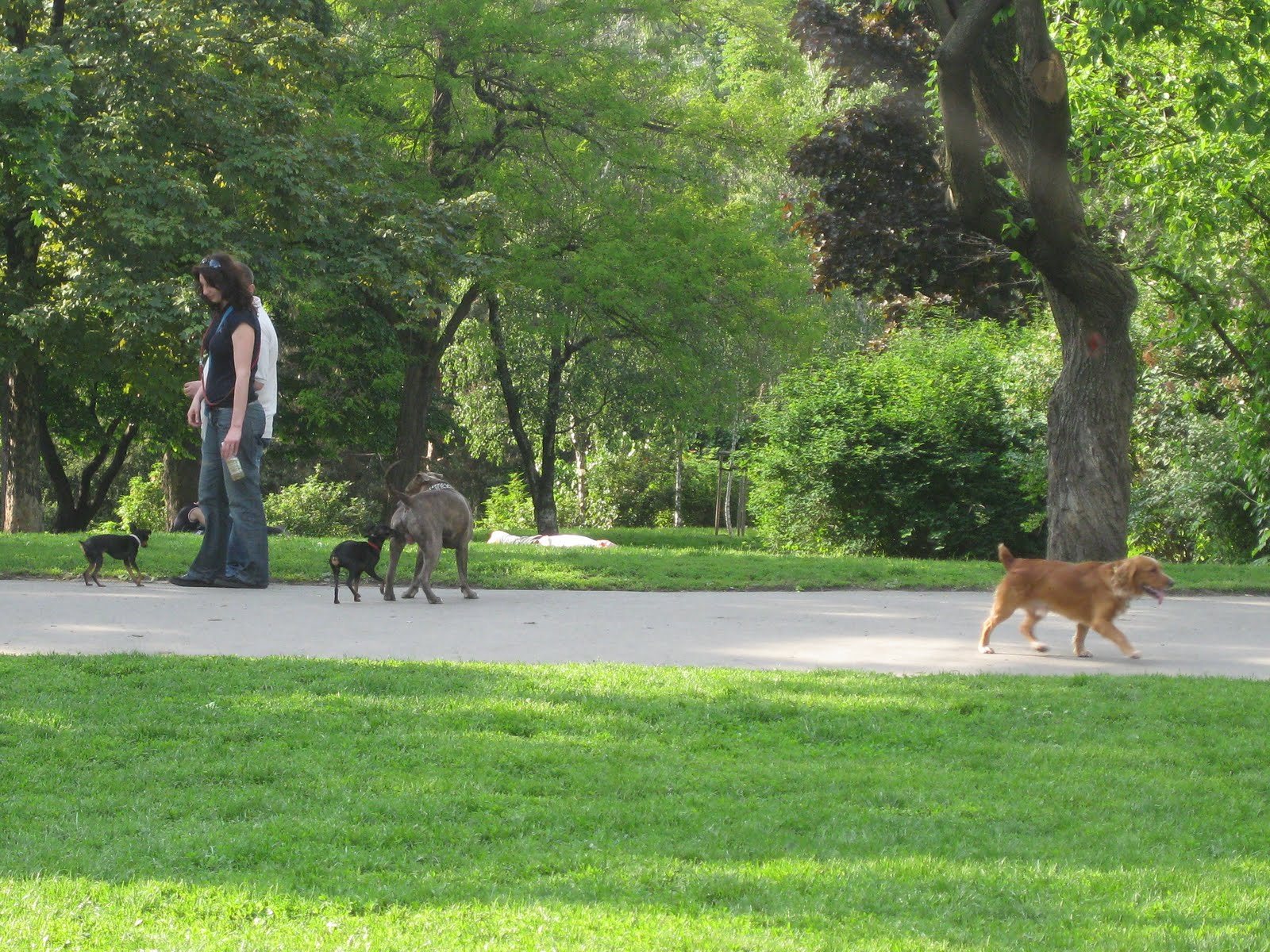
It's funny to think that a place once so unknown and foreign can become one of comfort. I remember vividly the first time I came across Riegrovy Sady. Covered in a thick blanket of snow I attempted to walk along it's icy paths. Well I didn't venture too far! A few months on and many visits later I now know it like the back of my hand. Making my way along its winding paths I come across many familiar sights - an array of dogs being walked by their owners, fellow runners passing by, friends laying and chatting on the grass, retirees sitting on benches and pondering life, and in the afternoons a group of tightrope walkers practicing on a rope connected to two thick tree trunks. This is Riegrovy - my own little 'haven' call it if you will.


Below are some photos of Riegrovy, followed by some other places I have come to know well during my time here.


Last traces of winter - Riegrovy's winding paths


Spring time - blossoming trees with 
the beer garden in the background


A familiar sight - dogs running about! 


Zizkov TV Tower


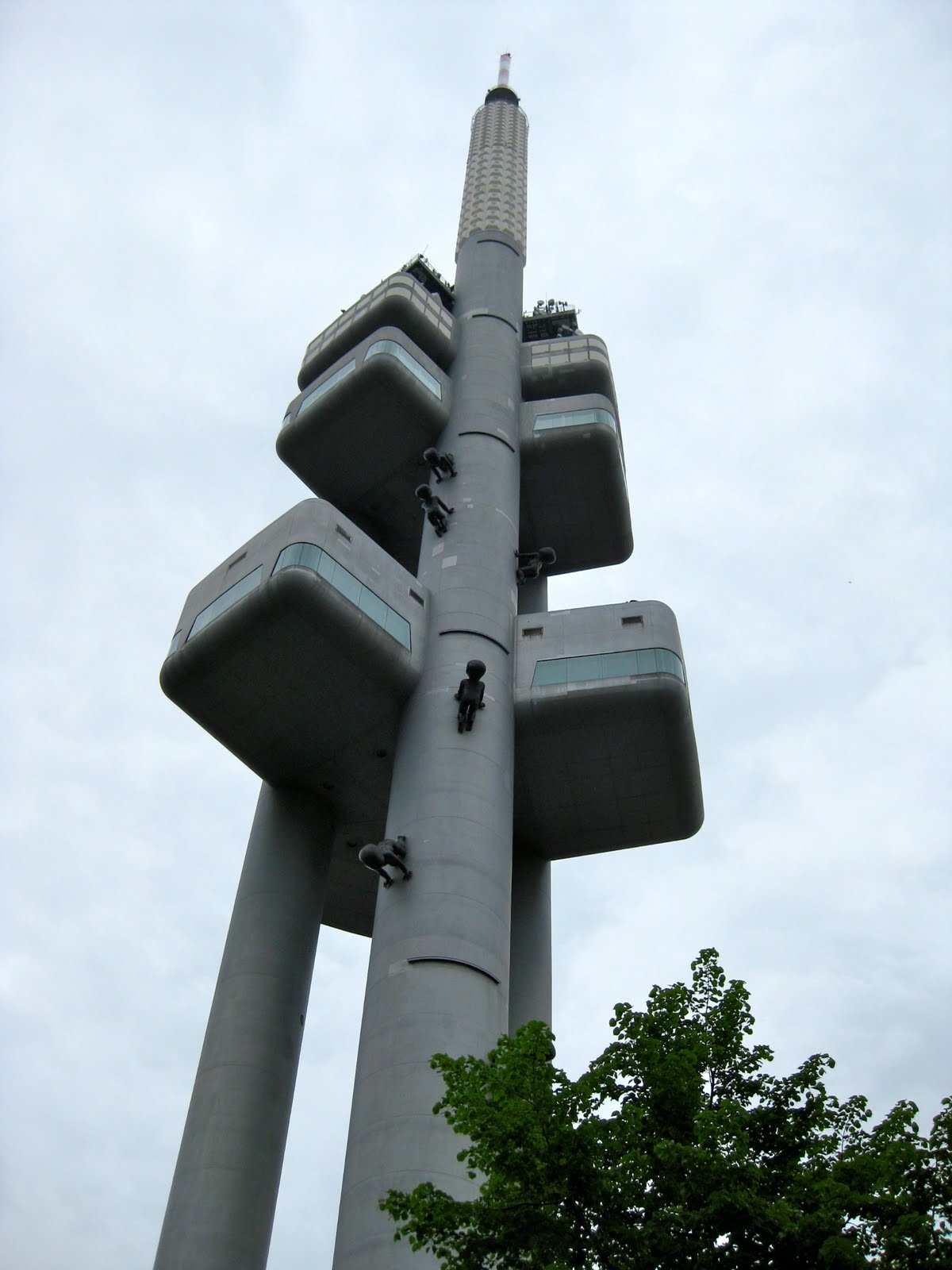
Probably the most bizarre structure I have ever come across - I have now grown to love it for all of its wackiness. At 216m, the silver TV transmitter is the tallest building in Prague. Designed by Vaclav Aulicky, it is famous Czech artist David Cerny's addition to the tower which has caused the latest controversy. Home to Cerny's giant, black 'computer babies' - ten faceless, crawling Miminka (babies) were added to the tower as part of Prague's contribution to the European City of Culture in 2000*. The addition caused much outcry among Prazaks but I think it is fair to say that they too have grown to love it. Visible from all over Prague, I consider it to be my own personal, residential pinpoint marker!


Jiriho z Podebrad Square


The square where you exit out of the metro stop of the same name, 'JZP' (which is what those who struggle with the Czech language refer to it as!) is anything but boring. The grand, brown and white church of The Most Sacred Heart of Our Lord dominates the area. From my apartment I can hear it's bells chiming on the hour. In fact, during the week it's first chimes at 7am act as an initial 'wake-up call' - notifying me of how much longer I have left in bed! Located atop the Zizkov/Vinohrady hill, it's imposing structure and aged, blue-coloured bronze cross pierce the city skyline from various high viewpoints around the city. Surrounded by a park with walkways and benches - locals, passersby and homeless hawkers (who while annoying are usually harmless) frequent the square. Around it's perimeter colourful buildings in the city's typical, historical style watch over the square's action as it unfolds.


Bila Vrana


Meaning 'white crow', Bila Vrana is an awesome little bar/restaurant located around the corner from me.    Having dined and drank there many times, it is fast becoming my local. A cosy atmosphere complete with fitting decor such as hanging bird cages, wooden seating and green, leafy plants, it is a great place to enjoy a few drinks, whether it be a glass of red or perhaps their tasty blended Kozel beer. Bila Vrana also offers patrons a varied and very affordable selection of food, with their menu including delights such as duck salad in plum sauce, garlic tiger prawns and creamy pumpkin, cheese and walnut risotto.


http://www.bilavrana.com


Parc Ferme


Another nearby haunt, this is a funky little cocktail bar where I have enjoyed lively conversations over drinks numerous times. You can sit in the front area by the bar or chill out in the back area on the red leather couch in the warmth of the orange lighting and decor. A cool album or soundtrack is always playing in the background, adding to the relaxed and stylish feel of the place.


http://www.parcferme.cz


Palac Akropolis


A popular Zizkov club, Palac Akropolis is unmissable with it's blue, yellow and green exterior. Dominantly positioned on the corner of two streets, it's interior is equally cool. Corridors lead to separate rooms each with their own DJ, bar and dance floor. There's a great vibe to the place with everything from electro beats, drum 'n' bass to rock playing. And being only a short walk from my place, it makes returning home from a night out a (relatively!) easy task.


http://www.palacakropolis.cz


Sudicka


This place was recommended to me by a few and after eating there it's not hard to see why. Located in Vinohrady, this cellar-converted restaurant has a very cosy and homely feel. Wooden flooring and seating, stone walls, shelves filled with books, photographs on walls and candles decorate the place. Sudicka has a great selection of wine and delectable food such as their much raved-about garlic cream soup, fondue, steak and couscous dishes.


http://www.sudicka.cz/


So as you can see Prague (in particular the area I live in) has very much become my home. I have and I'm sure will continue to enjoy discovering more new places and making them my own!


Australian in Prague


*Sources: http://www.radio.cz/en/article/33525, http://www.visitingprague.org/babies-in-tv-tower

Friday, June 25, 2010

"If a nation's culture survives, then so too does the nation." Jan Mladek

Laid-back, friendly, hard-working, competitive, patriotic. These are just some of the words that are commonly associated with Australians. The last is one I especially agree with. Australian patriotism is as much ingrained in our make-up as the sun and surf, and subsequently is evident in all areas of life. You only have to look at any international sporting event us 'Aussies' partake in, you'll always find a sea of green and gold fans fervently chanting "Aussie! Aussie! Aussie! Oi! Oi! Oi!" Or perhaps on ANZAC Day (a national day of remembrance on April 25 - initially for WWI Australian and New Zealand Army Corps but now commemorating all those who have died in military operations) where parades around the country are attended, BBQs lit and flags proudly displayed by both young and old in celebration of our country's independence.

There is no denying it, Australia is a great country to live in. But it is also a fairly young country and as such has a young history. Certainly one of the reasons I am living on this side of the world is because I am drawn to its history. Europe is very much a land of contrasts - contrasting landscapes, cities and people. It is history though that ultimately shapes people, and what a long and eventful one Europe boasts. Throughout the ages there have been many great discoveries and transformations in the arts, science, technology, infrastructure and so on. But with the good also comes the bad. Countless wars have been waged motivated by religion, land, ethnicity and ideology. In the 20th Century alone the names of Hitler, Stalin, Mussolini and Milosevic spring to mind, whose dictatorships resulted in much devastation and loss of human life. 


Czech History

With its central location in Europe, the Czech Republic has naturally been directly affected by many of these conflicts. In modern history, both the Nazi and Soviet Regimes have wielded their devastating power over the Czech people. From 1939 to 1945 the Nazis occupied Bohemia and Moravia (Czech parts of the then Czechoslovakia state). While Prague and indeed most of the Czech Republic were largely physically unscathed, the same can not be said for the Czech Jewish Community. Suffering much the same fate as Jews around Europe, some 80 000 Czech Jews lost their lives during WWII in holding and concentration camps.* As WWII drew to a close Czechoslovakia proclaimed independence in 1945, but it was to be short-lived. After the 1946 elections the Czech Communist Party formed a Coalition Government. Two years later they staged a coup d'etat, which essentially began the nation's long decline into decades of Communism. It was an era where restrictions were imposed in almost all areas of Czechs' lives, severely limiting their choice in travel, occupation, food, fashion, culture and political thought. It would not be until the end of 1989 when the Czechs would escape the suffocating mechanics of Communism, after the famous week-long demonstrations known as the Velvet Revolution. Initially an underground movement sparked by growing dissent towards the Communist regime, the Velvet Revolution or Gentle Revolution was a mostly peaceful movement, with the exception of November 17, 1989. Riot-police suppressed a non-violent student demonstration in Prague's Wenceslas square, which (much to the Communist's dismay) resulted in a swelling of support to the anti-Communist cause. The Revolution was largely led by writer and playwright Vaclav Havel. Havel garnered the support of important figures as well as university students, who further spread the message of political dissatisfaction amongst those in the working community and surrounding villages and towns. The result was a series of protests in Prague and other Czechoslovakian cities such as Brno, Ostrava and Bratislava, which culminated in the standing down of the Communist Party and the election of Havel as the first President of Czechoslovakia (and later The Czech Republic) post-Communism.*


Prague's Historical Reminders

In Prague there are constant reminders of these dark times. At the foot of Petrin Hill is the Memorial to the Victims of Communism, a provoking sculpture by Olbram Zoubek depicting 'broken' men in various stages and descending a set of stairs. Atop Letna Park and figuratively so the entire city, is artist Vratislav Karel Novak's giant red metronome. It replaced the world's largest statue of Joseph Stalin and symbolises the passage of time. Outside the National Museum a wooden cross is embedded in the walkway, marking the exact spot where university student Jan Palach set himself on fire and died in protest against the Soviet invasion in 1969.* But perhaps the most powerful reminder of all can be found in the silent form of art.


Museum Kampa

Over the weekend I visited yet another art gallery, Museum Kampa, and again I was blown away by the quality of art. Since living here, I have found the Czech Republic to be somewhat of a 'hidden European jewelbox', and have consequently enjoyed discovering its many gems. Originally the complex of the historical Sova's Mills, this gem has since been transformed into a Museum for Central European Modern Art. A striking, white, modern building with a clever and original layout, Museum Kampa houses a unique collection of art accumulated over the lifetime of Meda and her late-husband Jan Mladek (who is responsible for the title of this post). As Jan's quote so clearly articulates, the Mladek's believed that culture is the basis for a nation's survival. The collection hence reflects this belief, showcasing the works of artists who were persecuted, exiled or driven underground during Communism.

The collection included an impressive range of central European (mostly Czech) artists. The quality and presentation of the art was amazing, which had obviously been meticulously selected and grouped together. However it was the emotionally-evocative nature of the works which I found to be the most powerful. Discontentment, frustration, despair, numbness - these are just some of the raw emotions I felt and I believe the works intended to portray. The two biggest contributors of work though were Czechs Frantisek Kupka and Otto Gutfreund. I mentioned Kupka in one of my previous posts after first viewing his work at Narodni Galerie. Well I was further impressed by this artist's talent. A pioneer of abstract art, Kupka used a variety of materials and styles and as such has a wide and impressive repertoire of work. The second largely featured artist is Otto Gutfreund, who was a prominent Czech sculptor. Despite his short-lived life (he drowned from exhaustion while swimming in the Vltava River at the age of 38!),  he produced a great number of drawings and sculptures. I was especially drawn to his sculptures, which depicted extremely expressive faces and bodies. 

I have to also mention the location of Museum Kampa, as it made my experience all the more memorable. Situated on the bank of the Vltava River on Kampa Island (a green park area separated from Mala Strana by a small canal known as 'The Devil's Stream' or 'Prague's Little Venice'), the location was supremely prime. Making my way through the museum I'd often look out the window and find myself laying eyes on many of Prague's major sights - Prague Castle in all its grandeur, Charles Bridge with its blackened stone statues, Petrin Tower- the 'mini Eiffel Tower of Prague', The National Theatre with its intricate, gold roof and in the distance Old Town Square. You may think I'm locally biased, but there is really no better city backdrop in the world. Sometimes in all the hustle and bustle of life I forget just how spectacular and picturesque Prague is, but it is moments like these that make me love it all the more.

Below are some photos of the Museum itself, it's unforgettable views and a few of the works I found to be the most emotionally-evocative. A timeline of important 20th Century events in Czech history follows, with photos of the constant historical reminders around Prague.


Australian in Prague


The modern architecture of Kampa Museum

The eccentric row of yellow penguins on the Vltava River, which 
are lit up at night and lead the eye towards the famous Charles Bridge.

"Although they keep silent, the cry aloud; their silence is more 
expressive than words" - Jozef Lukomski

"Family Portrait" - Theodor Pistik

"We demand bread" - a widely-used slogan 
in anti-Communist demonstrations.

Simple and effective layout of Museum Kampa

Timeline of Important 20th Century Czech Events

- Beginning of the 20th Century: Czechs are part of the Hasburg Austro-Hungarian Empire.

- 1918: After the defeat of the Austro-Hungarian Empire in WWI Czechoslovakia is given it's independence on 28 October. Comprised of Bohemia, Moravia and Slovakia, Tomas Masaryk is the first President.

- 1938: In October the first Nazis arrive, occupying the German-speaking area of Sudetenland.

- 1939: The Nazis occupy Bohemia and Moravia in March, with Slovakia proclaiming independence as a Nazi 'puppet state'.

- 1939-1945: Some 80 000 Czech Jews die in Nazi holding and concentration camps.

- 1945: After WWII Czechoslovakia is reestablished as an independent state.

- 1946: During elections the Czech Communist Party receive the highest percentage of votes and form a coalition government. 

-1948: With the support of the Soviet Union, the Czech Communist Party stage a coup d'etat making Czechoslovakia a Communist country.

- 1960s: Czechoslovakia enjoys a slightly more 'liberal' Communist period led by Party leader Alexander Dubcek. During this time of 'socialism with a human face' there is resurgence in culture and relaxing of media restrictions. 

-1968: In what is referred to as the 'Prague Spring', Dubcek's period of liberal reforms ends when Soviet tanks invade Czechoslovakia in August. Dubcek is replaced by the orthodox Gustav Husak, beginning 20 years of Soviet influence.

-1969: In protest of the Soviet invasion, Czech student Jan Palack makes a sacrificial suicide pact with other students. He sets himself on fire in Wenceslas Square on 16 January and dies. Another two students - Jan Zavij also in Wenceslas Square and Evzen Plocek in Jihlava - die too by setting themselves on fire in the same year.

- 1977: Playwright Vaclav Havel, along with  242 other leading intellectuals and artists, sign a document called Charta 77 and begin campaigning for basic human rights.

- 1989: On 17 November violent police attack a peaceful protest rally in Wenceslas Square led by Vaclav Havel. It results in a swelling of public support and the staging of more demonstrations in Prague and other major Czechoslovakia cities. This week-long movement is known as the Velvet Revolution and results in the resigning of the Communist Government and the election of Havel as the first president of post-Communist Czechoslovakia.

- 1993: The Slovaks and Czechs peacefully split on 1 January, with Havel elected as the first President of the Czech Republic. He remains President until 2003 when he stands down and current President Vaclav Klaus takes his seat. 

Prague's Historical Reminders

Memorial to the Victims of Communism

Memorial to student Jan Palack - who burnt himself to death 
at this exact location (Wenceslas Square, 1969) in protest 
of the 1968 Soviet invasion.

The giant red metronome atop Letna Park, symbolising 
'the passage of time.'

Sources: http://www.czechsite.com/history.html, http://www.everyculture.com/Cr-Ga/Czech-Republic.html, Prague Encounter - Lonely Planet 2007, Museum Kampa

Tuesday, June 15, 2010

"Dogs are not our whole life, but they make our lives whole." Roger Caras

Growing up in Australia I find you tend to be either a dog or a cat lover. Personally I was the latter. My family always had cats and still does to this day. I believe your experiences - or lack thereof - with animals ultimately shape how you interact with them. As a result I didn't always feel comfortable around dogs, (particularly the bigger varieties!) unused to their lively and playful nature and sometimes even wary of being attacked.


Dog Hospitality


Since moving to Prague though that has all changed. I mentioned in one of my earlier posts how once Spring arrives quite literally 'every man and his dog' comes out and I wasn't kidding. In the warmer months Prague becomes 'dog city'. From dachshunds to dobermans, pugs to poodles and everything in between - everywhere you look there are dogs. And their presence isn't just limited to parks and pathways, dogs are accommodated for in bars, cafes and restaurants, on the metro, buses and trams, and even the zoo! Yes it's true, when I visited Prague Zoo a few weeks back I was shocked to see visitors walking through the grounds with their dogs in tow. What I found the most hilarious though was the provision of dog water bowls, which where randomly placed along the zoo's walkways. Back home you'd never find dog hospitality to this extreme, but this is Europe after all- the land of the liberal!


Dog Behaviour


What has also surprised me is their behaviour. Considering the number of dogs here in Prague, for the most part, they behave very well. Very rarely do you hear dogs barking, they don't fight one another and not once have I felt uncomfortable or that I was going to be attacked. In fact I've become quite the opposite, admiring the different breeds and often smiling (sometimes even 'cooing'!) to myself whenever an adorable little creature walks by. I remember vividly one such creature when I was waiting for the bus one February morning. Still adjusting to the European winter, my numbness was soon forgotten when my attention was diverted to a woman standing beside me. Cradled in her arms was a shivering little terrier, dressed in a Desperate Housewives-style, pink terry-towelling tracksuit complete with a matching pink clip in it's hair. Well, I melted. I guess you could say Prague has changed me, I've essentially become a dog-lover!


I believe my changed perception of dogs all boils down to the friendly and non-threatening way they interact with one another and humans. I've definitely noticed a difference between here and back home. That's not to say that dogs are badly behaved in Australia, but you do hear more barking (just ask my Dad!) and of more dog attacks/maulings. Perhaps this is because they are so well accommodated for here in Prague. Dogs are almost as much as part of the fabric of society as humans are and as such their interactions are, 99% of the time, positive in nature.


Here are just some of the dogs laws/rules in place in Prague...


- Dogs are allowed to ride on public transport (metros, buses, trams) provided they are on a leash and have a muzzle. Otherwise if they are small enough, they can be placed in a small bag or cage.


- In most public places, dogs must be kept on a leash at all times. In some parks they are allowed to roam free, but more often than not owners turn a blind eye to this rule.


- Owners are supposed to pick up dog feces, with fines applying if caught by the police. With the amount of 'matter' sometimes present on the streets this rule appears to not be heavily enforced, but nevertheless owners are encouraged to 'do the right thing' by the provision of 'poop' bags and bins around the city.


- Dogs are allowed in bars, cafes, restaurants and shops at the owner's discretion. At first it was rather bizarre to enter a bar and see a dog sitting beside his owner - I often wondered if I had drunk too much! But now I don't bat an eyelid, in fact (as informed by a dog-owner friend of mine) they often receive more superior service than their owner. I've been told that on arrival, it's not uncommon for a bowl of water to be fetched for the dog right away while the owner waits to be attended to!


So as you can see Prague is very much a dog-loving city. Definitely since living here this mentality has rubbed off on me, to the point where I could see myself someday soon becoming a dog-owner.


Below are some fun, dog-related snaps I've taken during my time here in Prague.


Australian in Prague


If was going to get a dog then a pug it would be!

A terrier, similar to the one I saw dressed in pink.


The adorable 'Ekko' - winning hearts everywhere he goes!


Hilarious! Dog water bowl at Prague Zoo.